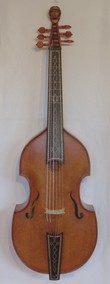
Andreas Jacobi
|
||
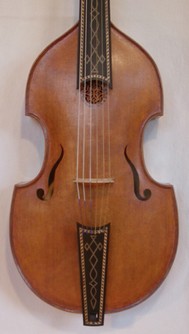
Copy of a Viola da Gamba by Andreas Jacobi, after an instrument of Hendrick Jacobs from the year 1680 |
||
|
The commission request was not to make an identical copy with all the traces and distortions caused by the passage of time, but rather a living, playable instrument based upon the appearance of the original, but also with corrections the outer form, as well as better bass bar and back plate stability. The back plates of historical gambi are often damaged or show traces of repairs and restauration, which indicate constructive, static deficits of the flat back plate in comparison to the modern, convex back plate. On the other hand, it is precisely the flat back plate which gives the viola da gamba its typical, slightly nasal sound quality. Here my decision was to make the back plate somewhat thicker than the original, and to round the edges slightly where they are glued to the ribs. The drawing obtained from the Gemeentemuseum in Den Haag delineates only the asymmetry of the back plate. It is possible, and because of the slightly warped placement of the ribs, probable, that Hendrick Jacobs used an inside mould and fitted the top plate and back silhouette to it. While studying the original in the museum I decided for a symmetrical outer shape for the rib construction. Thus both top and back plates have, in my copy, the same symmetrical contour and the differences in the outline of back and front -in contrast to the original – are kept to a minimum.
Now I wish to describe some specific parts of the instrument, beginning with the inlays.
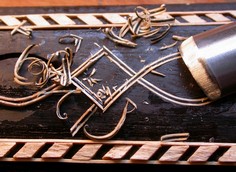
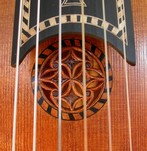
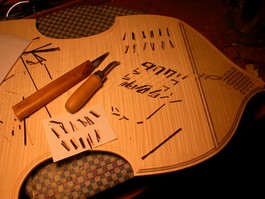
Each section of purfling was fitted into the inlay groove, held at the end at the proper angle and only then were the three shaving strips glued. The procedure is complicated, but when the instrument is finished it creates a slight irregularity, which, given the amount of purfling on the back of the instrument, effectively prevents a too industrial, sterile appearance. The picture on the left shows the sorted and cut shavings, the second picture a detail of the middle of the back plate of the finished instrument. The purposeful unevenness of the surface and the variances of thickness can be clearly recognized. The third picture shows the back plate of the copy with all of Hendrick Jacobs' beautifully proportioned diamond patterning and the double inlay along the edge.
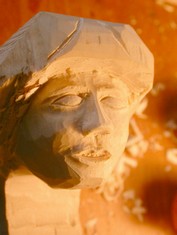
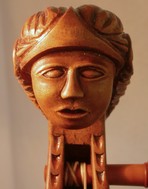
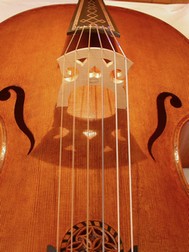
The neck of the Gamba is richly decorated with wood carvings and both the fingerboard and tailpiece are intricately inlaid.
Following
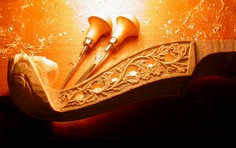
the original, the entire pegbox and „head“ are decorated with botanical
elements from the oak: the walls of the pegbox are an oak branch, complete
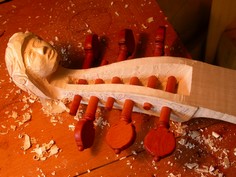
with carved leaves and acorns. Before beginning to carve I inserted the pegs,
as they seem to arise out of the curves of the branch
and twigs. The main branch
The
narrowing
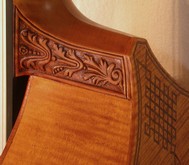
The style of the carvings at the base of the neck is different from that of the pegbox, both in the original and in my copy, as shown in the picture pair:
The
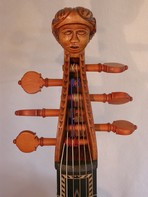
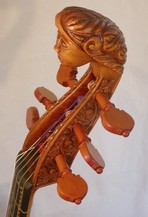
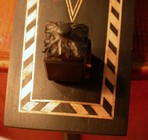
fingerboard and tailpiece are not, as in The picture on the right shows the carved head and the tailpiece.
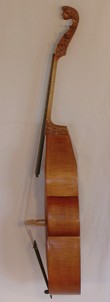
The following pictures show the copy next to one another:
|
||

 Hendrick
Jacobs was one of the most important Dutch violin makers of the Baroque. His
works are both beautiful in form and demonstrate craftsmanship at a high
level. The Viola da Gamba described here copying due both to size (Body
length of 69,7 cm and playable string length of 71 cm) and sheer beauty.
Hendrick
Jacobs was one of the most important Dutch violin makers of the Baroque. His
works are both beautiful in form and demonstrate craftsmanship at a high
level. The Viola da Gamba described here copying due both to size (Body
length of 69,7 cm and playable string length of 71 cm) and sheer beauty.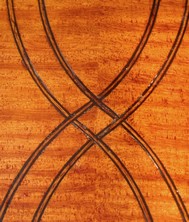
 Hendrick
Jacobs generally used whalebone for his purfling, a practice no longer
possible due to the need to protect whales. I chose to use a triple swarf
with ebony edging a center of poplar-wood. In order to achieve a more
interesting appearance – and one that evokes
Hendrick
Jacobs generally used whalebone for his purfling, a practice no longer
possible due to the need to protect whales. I chose to use a triple swarf
with ebony edging a center of poplar-wood. In order to achieve a more
interesting appearance – and one that evokes